Below are the results of the surveys regarding the historic approval rating of President Dina Boluarte Zegarra for the 2023-2026 term.
The data will be updated based on the results disseminated by the media and published by the organizations conducting the research with national, urban, and rural coverage, although keeping in mind that the methodologies and sampling frames differ.
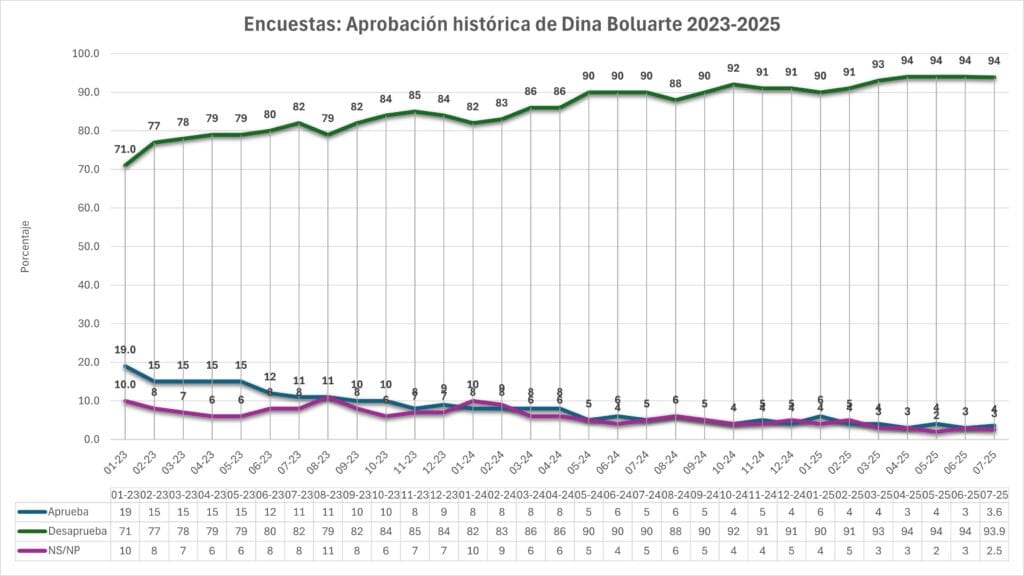
The accompanying graph shows the evolution of polls on Dina Boluarte Zegarra’s historical approval ratings from January 2023 to April 2025, highlighting trends reflecting public perceptions of her administration.
It is important to note that these trends not only reflect overall approval or disapproval, but also allow us to identify the specific factors influencing public opinion.
Year 2025
For example, the trend in public opinion regarding citizen insecurity continues to be observed. According to the IEP’s March report, the perception of insecurity is the country’s main problem for 50% of those interviewed.[1]
Meanwhile, the Ipsos report emphasizes the management of former Interior Minister Juan José Santiváñez, who was censured by Congress and whose disapproval rating reached 77%.[2]
As can be seen, both studies find similar trends in identifying citizen insecurity as the central issue of public concern, albeit with different approaches.
Apparently, citizen insecurity continues to influence the presidential approval ratings, as incidents of violence affecting the lives and property of citizens continue to be reported.
The government has made withdrawn announcements to combat crime, and authorities have implemented programs and actions to address the problem. In the public’s view, the results are not achieving the expected results.
En conclusión, los resultados de las encuestas sobre la aprobación de Dina Boluarte Zegarra en lo que va del año 2025 reflejan una tendencia clara: la inseguridad ciudadana sigue siendo un tema central en la opinión pública.
Year 2024
According to polls conducted in 2024, the administration of President Dina Boluarte is marked by a steady increase in disapproval, as shown in the graph below.
According to the polls, Dina Boluarte’s approval rating began at 8% in January 2024 and ended at 4%; while her disapproval rating began at 82% and closed at 91% in December.
President Dina Boluarte’s changes in ministers of state were not a factor that improved her approval rating. On the contrary, she was a constant throughout her term: high turnover of ministers and, consequently, the constant reshuffling of government teams.
It should be recalled that the President of the Republic reorganized her cabinet of ministers in March 2024, with Gustavo Lino Adrianzén Olaya becoming President of the Council of Ministers.[3]
The IEP’s May 2024 report was the month in which Dina Boluarte’s approval rating reached 5%, the lowest percentage up to that point. The results are explained by public perceptions of corruption in her administration and her personal financial situation..[4]
The year began with growing concern about citizen insecurity, which, while not occupying the top two spots as a citizen concern, gradually rose until it reached first place in November 2024.
According to the November 2024 IEP survey, 90% of respondents considered security to be worse than the previous year. Meanwhile, 82% of respondents responded that corruption had increased compared to the previous 12 months.[5]
In short, polls on President Dina Boluarte Zegarra’s approval rating show that she faced growing public disapproval due to multiple factors, including perceptions of corruption, political instability reflected in constant ministerial changes, and the direct impact of insecurity and the economic situation on citizens’ daily lives—all of which may have shaped a political context marked by distrust and discontent.
Year 2023
Boluarte’s administration began on December 7, 2022, after former President Pedro Castillo was arrested for issuing a proclamation through the media in which he illegally and unconstitutionally dissolved the Congress of the Republic and its subsequent vacancy by this branch of the State.
Dina Boluarte assumed her mandate facing protests and social mobilizations that were unleashed in regions such as Puno, Cusco, Arequipa and to a lesser extent in Lima that marked the public agenda.
The protests were violently repressed, causing the death of 50 citizens, a situation widely questioned by national and international human rights organizations.
At the same time, the presidential succession carried out in a previous climate of political confrontation between Congress and the Executive Branch, plus the protests repressed with deaths, generated distrust and the lack of legitimacy in the new government management.
According to the Ipsos poll conducted in December 2023, Dina Boluarte began her term with a citizen approval rating of 19%. However, this support progressively decreased each month, until it reached 9% at the end of the year, consolidating a downward trend that could continue in the future.
Although the social protests were finally silenced and the political situation apparently returned to calm, public opinion marked a position regarding the government of Dina Boluarte, According to the same Ipsos poll, disapproval of the government reached 84% in December 2023.
Data source:
- Data for April and June 2025 are from Ipsos – Market Research, while data for May and July 2025 are from Ipsos – Market Research.
- Data for January and March 2025 are from the Research Department of the Institute of Peruvian Studies (IEP), while data for February and April 2025 are from Ipsos – Market Research.
- Data for January, March, May, July, August, September, and November 2024 are from the Research Department of the Institute of Peruvian Studies (IEP), while data for February, April, June, October, and December 2024 are from Ipsos – Market Research.
- Data for January – December 2023 are from the Research Department of the Institute of Peruvian Studies (IEP).
Methodologies: Data for the IEP studies were collected via a nationwide telephone survey (urban and rural) on the dates described in their respective data sheets, with a margin of error of ±2.8% and a level of representativeness exceeding 90%.
Ipsos collected its data via face-to-face household surveys (urban and rural) using mobile devices, on the dates indicated in their respective data sheets, with a margin of error of ±2.8%.
Quotes: